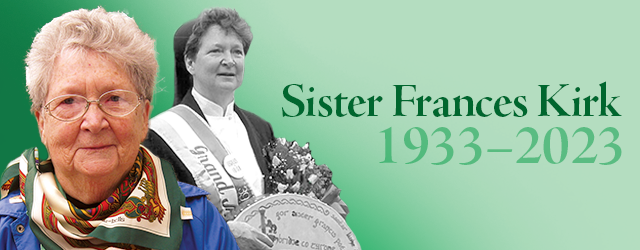
Sister Frances Kirk

By Lori Lander Murphy

Hall of Fame
Irish Center

“Unless you saw the pictures of Belfast and the conflicts, you could not understand it. You don’t realize how lucky we are.”

On Sunday, November 18, 2018, when Sister Frances Kirk, SSJ, is honored by the Delaware Valley Irish Hall of Fame, it will be for a lifetime devoted to education and service. But it was as chairperson and organizer of Project Children for over 30 years that she was able to make an extraordinary impact on the lives of thousands of children in both the United States and Ireland.

Born in 1932 in Northeast Philadelphia to parents Frank Joseph Kirk and Elizabeth Rose “Lizzie” Falls, who had come over from County Tyrone in the early 1920s, Sister Frances has always embraced her Irish heritage. Nine of the 14 siblings in her mother’s family left their village of Glenelly Valley to make Philadelphia their home, but they kept in close touch with the ones who stayed behind. “Letters, letters, letters,” Sister Frances explained. “And money, money, money. Every letter had to have a five pound note in it. There was no money at home.”

The oldest of the five siblings in her own family, Sister Frances came to the convent at age 19. Though she took a year off after graduating high school to work, she had no doubt that her life would be devoted to the Sisters of St. Joseph.

“I knew in first grade that I wanted to follow in the footsteps of the nuns who taught me; I was very much influenced by my primary teachers. I went to St. Leo’s in Tacony, and then to St. Hubert High School. I wanted to do the same for the pupils I taught that they had done for me.”

Her dedication and assurance has served her well. Sister Frances is a graduate of Chestnut Hill College with a degree in business science, and she earned an M.A. at Glassboro College. During her career she has been both teacher and principal, and she continued her own education even as she was guiding and instructing her students.

It was in 1975, during the height of The Troubles in Northern Ireland, that Dennis Mulcahy founded Project Children. The Cork born member of the NYPD’s Bomb Squad created the program as a way of bringing both Catholic and Protestant children over to the US from Belfast to spend the summer away from the violence that ruled their lives. It would also provide them with the opportunity to learn that kids who practiced a different religion weren’t the enemy.

That summer, Sister Frances was attending Rutgers University on a National Science Foundation Grant and preparing for a career change to a school in Vineland, NJ. She was living in a convent near Rutgers, and happened to see a photo of two girls from Belfast who were being hosted by a family in the parish. She immediately wanted to know more.

“I asked if anybody knew this family, and I got their telephone number so I could get in touch with them. I found out that they had 10 children of their own and I said, ‘How do you include two more children when you already have 10?’ And they said, ‘It’s easy.’

“When I told them I was interested, they told me that I would have to sell chances to raise money to bring the kids over. At that time, each child cost $300 for airfare and insurance. I said that I was about to start at a new school, and I would try to sell chances, but I didn’t know how it would go, that I’d be getting adjusted to a new environment.

“It went very well. I met people there who were interested in helping. There were several moms who knew what was going on in Belfast and one of them organized a spaghetti dinner at Sacred Heart in Vineland. She raised over $3,000. I was overwhelmed. Just overwhelmed.”

A few years later when she left Vineland and went back to Philadelphia, in addition to her career in education and promoting Project Children, Sister Frances also became the Chaplain for the Ladies Division 39 of the Ancient Order of Hibernians. With their help, word spread among the Irish Community, funds continued to be raised and more families volunteered to host children for the summer. They brought over a “planeload of kids. Every year I went to New York and met the hosts. We’d take a certain amount on the bus, and they’d hold up welcome signs for the kids.

“In New York, they were met by the fire department trucks. They sprayed the Aer Lingus plane with green water, which overwhelmed the host families watching the plane land. But the kids didn’t realize it was just for them – they thought everybody got greeted like that!”

“I always had back-up host families, like my two sisters, who had kids. Mary had six kids and Peg had four, and they were there in case I got a call that a situation wasn’t working out. It happened. Sometimes the kids in the suburbs did not understand the kids from Belfast. Sometimes kids get along…and sometimes they don’t. If the families understood the conflicts in Ireland, they were better equipped to take care of these kids.

“But it always worked out. There are a lot of stories. One child said, ‘That cop was very nice to us.’ And you only had to know what he experienced. Once when I brought one of the kids into a house, they had a dog. And he said, ‘Soldiers shoot dogs.’ That was a realization for me. The soldiers came in tanks up the narrow streets of little Belfast, the dogs’ ears picked up that sound, and they would charge the soldiers, go to bite their boots. These soldiers were young Englishman. Some of them were the children of Irish parents who had gone to England. They were scared too. And sometimes they shot the dogs. That was those kids’ life experience.

“It was an eye opener for them to see how Protestants and Catholics got along over here. The Protestant kids were shocked that the Catholic kids were so nice. And the Catholic kids were shocked that the Protestant kids were so nice. They didn’t understand why it was so different in Ireland.”

Sister Frances knows that Project Children made a difference. Lifelong friendships were forged. Families here kept in touch with the children back in Ireland and many host families were invited to go over for the weddings of the kids who had stayed with them. Sometimes they were bridesmaids and groomsmen. Most importantly, walls were knocked down and prejudices were stripped away. In the words of Sister Frances at the end of our interview, “We all believe in the same God.”

5 Questions for Sabina Clarke

Interviewed by Katharine Gilbert

1. Congratulations! Your book Telling Stories is out now and available on Amazon. Can you tell us how you feel about completing your book? And what’s next?

Mixed emotions—probably relief that it is over maybe a tinge of post-partum depression and of course gratitude that there is interest and that people have reacted with some enthusiasm.  I would prefer to relax on the beach with a Pina colada…but soon will be collaborating again with my co-writer Thom Nickels. We will be adding a few new scenes and two or three new characters to the Merton play with the hope of staging it again in either September or October at a venue in Chestnut Hill—to be announced.  Perhaps we can have pina coladas while we work and I won’t feel deprived.

2. There is a fine art to an interesting interview—one which captivates the reader and reveals  something unusual—more than the expected. How do you find that topic or question and has it ever backfired?

It is important to establish trust, rapport and respect.  I think that you need to meet the interviewee on a personal and professional level.  From an early age, I was always coming home with stories about people which could be exasperating to the listener. This will give you an idea to the extent that I talked about almost everyone I was interested in—and there were so many personalities that captivated me. I recall an interview with Paul Murphy, the Northern Ireland Secretary of State on March 15, 2005 before he spoke at the World Affairs Council. I started off with a question that could have easily backfired:  ‘What do you think of Gerry Adams and his contribution to the Peace Process?’  Later that day, at a reception for Adams at the Hyatt Hotel on the River, I told Adams what transpired and he laughed.

3. In your book, your interviews span the arts, sports, religion, politics…here and abroad. How did you decide what to include and why?

The litmus test is probably people who pursue the greater good—a worthy cause beyond themselves. These are the people I admire so much. Also people who are achievers in their field and people who give back to society. There is something unique about everyone I have interviewed—also there is always something newsworthy.

4. The times I have been present to photograph the interviewee, you seemed to have had an instant rapport with the person before you started the questions—how do you do that?

I really like the people I interview—there seems to be an instant connection because there is. I only pursue interviews with people I am genuinely interested in and the connection is mutual and instant because the interviewee can tell immediately if you are interested in them on a personal level as well as a professional level.

5. Your play Rendezvous in Bangkok…Who Killed Thomas Merton which you co-wrote with Thom Nickels was very well received last September and now your book Telling Stories is out…although seemingly unrelated…can you compare the process of writing in one form to the other? Is there a difference and why?

There is quite a big difference between the two forms of writing—particularly in the process. Obviously, when writing alone you are your own critic – so you wear two hats all through the process of a narrative. In playwriting with a collaborator, you both write dialogue solely and then come together  to critique what you have written and  you bounce ideas off each—so there is collaboration all through and it is important to work with someone with the same sensibilities. Writing a book—whether it is a collection of interviews or a novel, you are on your own. This can be daunting but also very satisfying because it is not to be taken lightly. You put yourself out there to be judged.  

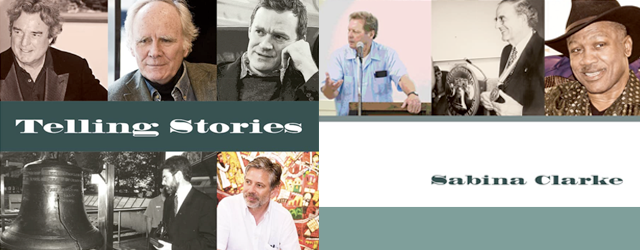
Telling Stories — 44 Interviews Over the Years

by Sabina Clarke

Telling Stories can be purchased on Amazon.

Telling Stories is a collection of 44 interviews over the years — that appeared in the Irish Edition newspaper and other publications. Among the interviewees are Gerry Adams; Senator George Mitchell; John Dean;  Bernadette Devlin; Jamie Wyeth; James Carroll; Edna O’Brien; Mary Gordon; Jesse Ventura; Dick Morris; Jay McInerney; David Talbot…and John O’Brien a former silk screen printer who was abducted by aliens and Lorna Byrne, a mystic who converses with angels and has seen them physically since she was a child, Major events in our nation’s history such as the tragedy of September 11, 2001 are reflected in the personal tales of Bob McIlvaine, a father who lost his son and has made it his life’s mission to uncover the truth of who was behind the deadly attack and Bonnie McEneaney, a woman who lost her husband on 9/11 whom she says “foresaw his own death”.

Telling Stories can be purchased on Amazon.

Photos © Katharine Gilbert

A Tribute to Mick Moloney

Presented by Irish Arts Center and NYU Glucksman Ireland House

Mar 30, 2023 – Apr 1, 2023

More than two dozen artists influenced by the late, great Mick Moloney come together at Irish Arts Center for a three-night musical celebration of his remarkable life and legacy

Most performances are full, although some seats are likely to be released this week…

Details:
$25–76 (inclusive of fees) 2 hours

Box Office:
888-616-0274
boxoffice@irishartscenter.org
Phone hours:
10am-6pm, Monday-Friday

Location:
Irish Arts Center 
726 11th Avenue
Hell’s Kitchen, NYC

FEATURED ARTISTS:
(lineup is subject to change)
Tim Britton
Nora Brown
Jean Butler
Darrah Carr
Donie Carroll
Liz Carroll
Brenda Castles
Stephanie Coleman
Mary Coogan
Rosemary Cooper
Tony DeMarco
Cheick Hamala Diabate
Brendan Dolan
Megan Downes
Séamus Egan
Donny Golden
Ivan Goff
Jefferson Hamer
Liz Hanley
Kieran Jordan
James Keane
Tamar Korn
Dan Levinson
Joanie Madden
Billy McComiskey
Mirella Murray
Dan Neely
Eamon O’Leary
Niall O’Leary
John Roberts
Leni Sloan
Athena Tergis
Caitlin Warbelow

MUSICAL DIRECTION:
Athena Tergis and Séamus Egan

PRESENTED BY:
Irish Arts Center and NYU Glucksman Ireland House

This program was made possible in part through generous support from Mary Lou and Joe Quinlan. Also presented with generous support from the National Endowment for the Arts.

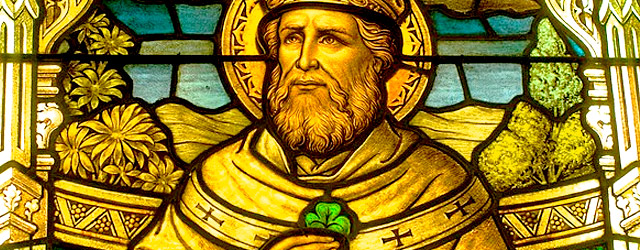
St. Patrick of Ireland and All Our World! — Patron for Persons on Life’s Periphery

By Msgr. Francis A. Carbine

“My name is Patrick. I am a sinner, a simple country person, and the least of all believers. I was about sixteen at the time, and I did not know the true God. I was taken into captivity in Ireland.

“After I arrived in Ireland, I tended sheep every day for six years. I remained in the woods and on the mountain, and I would rise to pray before dawn in the snow and ice and rain. As I realize now, the Spirit was burning in me at that time.

“It was one night in my sleep that I heard a voice, ‘Very soon you will return to your native country. Look, your ship is ready.’  After three days we made it to land.

“A few years later, I heard the voice, ‘We beg you, holy boy, to come and walk again among us.’

“How has this happened in Ireland? Never before did they know of God. But now, they have become the people of the Lord.

“This is my ‘Confession’ before I die.”

Patrick wrote his “Confessions” [extracts provided] — his story of discovering  faith and mission. He worked in the 5th century when civilization was in collapse.

Patrick also wrote his “Letter to Coroticus” protesting the killing and enslavement of Irish Christians by an English warlord, Coroticus.  Patrick is thus the first person known to forthrightly condemn slavery.  

In his “Letter to Coroticus” our Saint writes: “I do not know whether to weep more for those killed or those who are captives.”

He calls the predators “wolves and gangsters,”  and laments : “My voice is raised in sorrow and mourning.”

ST. PATRICK IS FREEDOM’S CHAMPION AND GOD’S HERO!
CELEBRATE WE MUST!

Click here to zoom in and read

Special to the Irish Edition — Breaking News

By Sabina Clarke

We have been notified that there will be an unveiling of a specially commissioned sculpture of Princess Grace of Monaco by Mayo sculptor Mark Rode—who designed the bust of former President Obama in Moneygall—on Thursday, March 16th   in Newport, County Mayo, Ireland. The event will be open to the public and followed by a reception in Hotel Newport.

Artist’s rendition of sculpture of Princess Grace of Monaco

His Serene Highness, Prince Albert of Monaco who personally selected the image for the sculpture will be joined at the unveiling by his cousin J.B. Kelly, of Philadelphia, son of John B. Kelly, Jr and a candidate for the At-Large seat on Philadelphia’s City Council.

Prince Albert of Monaco and his first cousin JB Kelly of Philadelphia join The Princess Grace sculpture in Newport Co. Mayo Ireland | Photo credit: Pauline McNulty

The statue, situated on Castlebar Street at the entrance to Newport’s landmark seven arch viaduct is the Newport Business Association’s  celebration of the ‘Town of the Two Graces’ — a way to commemorate two iconic women and their connections to Newport: Grainne Uaile  (Grace O’Malley) from the 16th century and Grace Kelly from the 20th century.

Princess Grace’s ancestors hailed from Drimurla  just outside Newport and both she and her son had previously visited the town. The statue of Grainne Uaile will be unveiled later in the year.

The former Grace Kelly has deep ties to Philadelphia, her birthplace and to her Irish roots. This latest honor is just one more homage to the bonds that exist between Ireland and the City of Brotherly Love and further testament to her lasting legacy.

A Letter from Ireland — Mary Lou McDonald and Ciarán Quinn

On the Death of Rita O’Hare

By Mary Lou McDonald

“I am deeply saddened by the news that Rita O’Hare – a powerhouse within Sinn Féin and the Irish republican struggle – has died. It is a sad day for Republicans throughout the length and breadth of Ireland and for Rita’s many friends beyond these shores, particularly in the United States. But above all, this is a devastating loss for Rita’s husband Brendan, her children Terry, Frances, Rory and Ciaran, her grandchildren, great grandchildren, her brother Alan and members of the wider family.

“Rita O’Hare has been an influential Republican activist for decades and an important figure in the Irish Peace Process. An integral part of the Sinn Féin leadership at important stages of the party’s development and during era-defining stages of the Peace Process, Rita worked with great drive, energy and ability for the unity of Ireland, for a more just society, and for the cause of peace and reconciliation

“A highly intelligent and strategic political thinker, Rita was also an articulate communicator and skilled publicist who was to the fore in pushing the boundaries, allowing Sinn Féin to develop into the modern, successful and popular political party that it is today. Rita’s key role in these developments will be her enduring political legacy.

“Rita was born and raised in Belfast, at a time when the north was an apartheid state, defined by sectarian discrimination and the marginalisation and oppression of the nationalist community. Her mother Maureen came from the nationalist Ballymacarett (Short Strand) area in East Belfast, while her father Billy was a socialist and internationalist who was born a Protestant in East Belfast to an English father and Welsh mother.

“Rita became involved in the Civil Rights campaign and later in Republican resistance to British state repression. Forced to go ‘on the run’ in the early 1970s, for her active opposition to British rule and military aggression, Rita later settled with her family in Dublin. She remained a dedicated and committed Republican activist and was imprisoned for three years in this state for her republican activities. A British attempt to have Rita extradited was blocked by the High Court in 1978 when it ruled that her alleged offences were clearly political.

“Over subsequent years, Rita served as Editor of An Phoblacht; Sinn Féin Director of Publicity; General Secretary; and Party Representative to the United States. She was a key figure in building and sustaining US support during crucial years of the Peace Process, working with the representatives of various US administrations. She was a tireless, assiduous and effective worker and in whatever capacity she served, she encouraged the highest standards among her colleagues.

“Rita was also a loving partner, mother, grandmother and great grandmother who was immensely proud of her children, grandchildren and great grandchildren. On my own behalf and that of Sinn Féin, I wish to offer heartfelt condolences to Brendan and to all the family.

“Ireland has lost a genuine patriot. Sinn Féin has lost a talented and valued comrade and we have all lost a very special and very dear friend. Suaimhneas sioraí dá hAnam.”

Mary Lou McDonald is the President of Sinn Féin

Taking Up the Baton

By Ciarán Quinn

a Chara,
This week we lost Rita O’Hare. She was a friend, a comrade, and mentor, and at times tormentor.

Many knew her longer and better than me. Those who can write better than I ever will of the woman we lost. Niall O’Dowd captured the essence of Rita as an activist in his piece on Irish Central. Mary Lou gave an incredible eulogy describing the urgent energy of a woman “who did not know her place”.

There were former prisoners and IRA volunteers, grown old and grey, carrying with dignity their unconquerable revolutionary spirit. There were neighbors, friends, and family. The new generation of Sinn Féin leaders and younger activists. I was proud to be asked to coordinate with her friends from the US who had traveled over. Many more tuned in to watch the service online.

I had not been to Glasnevin before the funeral. Had never made the time. As the US delegation carried the coffin on the final leg to the Republican Garden of Remembrance, I spotted the grave of John Devoy; “The greatest ever Fenian”, who lived and organized most of his life in exile in the US.

It was at this spot that Gerry Adams gave his oration. He acknowledged her role as an IRA volunteer, her work in Sinn Féin, and her essential role in developing and embedding the peace process. He thanked her family for sharing her with us. He asked the Grandchildren to carry the stories of Rita with pride. “Tell them that before they were born she fought for them and their future, so that you will all grow old in a free and united Ireland.”

Rita was part of something bigger than herself. Bigger than any one person.

Speaking about Irish Republicanism Gerry said, “It is a continuum. Like a relay race with each generation of activists passing the baton on to the next generation.”

The righting of wrongs and the struggle for justice continues. It may take different forms. it evolves and changes as progress is made. It never stands still. The graves at Glasnevin are proof that the struggle was there before we were born and will continue when we are gone until an Irish republic of equal citizens is established.

We are part of what came before and of what will follow. It is our role to progress Irish unity and build a true republic of all who share this island. Rita O’Hare played her part and made a difference.

This generation will not have to make the sacrifices of previous years. There is a peaceful and democratic pathway ahead. That is the gift and legacy of the generation of Rita O’Hare. The baton has been passed on. It is up to all of us and to those who follow to win the race.

Rest easy Rita

Ciarán Quinn is the Sinn Féin Representative to North America

Thomas Moore: Ireland’s Minstrel Boy—“Land of Song” Said the Warrior Bard

By Msgr. Francis A. Carbine

On St. Patrick’s Day, 1952, I stood on the steps of his Cathedral, New York City, as a parade watcher. I was in high school. I can yet hear the bagpipes echoing off the walls of the stone canyon that is Fifth Avenue. The song that I so well recall these 70 years later is Thomas Moore’s, “The Minstrel Boy.”

Lyrics tell the story of a young “warrior bard” who died fighting for Ireland. England, however, is never mentioned. He slings his harp onto his back and takes up his father’s sword. As the boy falls in death, he smashes his harp because “The songs were made for the pure and free./They shall never sound in slavery.”

This bracing elegy is bagpipers favorite on St. Patrick’s Day. “Minstrel Boy” emphatically endorses Ireland’s freedom. Moore’s lyrics are also a universal lament for countless young soldiers who have died in wars. The Vietnam Memorial in Washington lists 58,300 names – most of whom died young. Killed in action were three Gold Star alumni of Cardinal O’Hara High School, Springfield:  Charles F. McGrath, age 20; James J. McCaffrey, age 20; and Johnny J. Miller, age 22.

Dating from 1813, “The Minstrel Boy” was played by pipers  serving Irish Brigades in the American Civil War. In 2001, this song accompanied funeral of Father Mychal Judge, Fire Chaplain and first official victim of bombing of New York’s Trade Center.

Thomas Moore was born in Dublin, 1779,  and attended Trinity College. As a Catholic he was not permitted to receive scholastic prizes. He knew Lord Edward Fitzgerald, architect of failed rebellion in 1798. After receiving 500 lashes, he died in prison.

Moore was also schoolmate of Robert Emmet, Irish patriot hanged and then beheaded in Dublin, 1803. Some 30,000 Irishmen were subsequently killed or transported to Australia.

Moore daringly wrote biography of Fitzgerald, and bravely composed “O Breathe Not His Name” in memory of Robert Emmet. His fiancé, Sarah Curran, subsequently married and died in Italy.  “She is far from the land where her young hero sleeps.”

Ireland in early years of 19th century was described by Moore in his “Journal” as a place of “misery and filth … degradation and enslavement of the Irish people.” Goal of Queen Elizabeth I had been to reduce Ireland to ”carcasses and ashes.” A reward of five pounds was set on the head of a “romish priest – exactly the sum for the head of a dead wolf.”

King George III refused any accommodation to Catholics lest he violate his Coronation Oath in which he pledged to maintain “the Protestant Reformed Religion.” [This anachronistic oath will be taken by King Charles III.]

Irishmen, however, had caught the spirit of the French Revolution, 1789. The Irish yearning for independence surged.  In 1824. Moore anonymously published “Memoirs of Captain Rock” attacking with biting realism the degradation of Ireland by English occupiers.

Moore, an early romantic poet, invited Irish people to reflect on the era when Brian Boru was High King, St. Malachy wore his collar of gold, and the Red Branch Knights of Ulster performed deeds of unrivalled greatness. Moore celebrated the age before “the emerald gem of the Western world was set in the crown of the stranger.”

Culturally deprived, Irishmen may not have been able to read, but they were able to sing. And what they sang were the lyrics of Thomas Moore. Between 1808 and 1834, he published 130 songs — “Irish Melodies.” He used ancient tunes. The voice of Ireland, long repressed, began to be heard. The harp that for centuries had hung mute on Tara’s walls, sounded again.

Some songs were forthrightly sentimental: “Tis the last rose of summer left blooming alone…”; and “Sad, silent and dark, be the tears that we shed…” Sentiment, however, also has  validity: “The heart that has truly loved, never forgets!”

Patriotism, often tempered with nostalgia, animated many lyrics: “Remember the glories of Brian the Brave…But enough of the glory remains on each sword/to light us to victory yet!” Tara, dwelling of Ireland’s High Kings, recalled “the chiefs and ladies bright” who assembled there “in the pride of former days.” Seamus Heaney later spoke of Moore’s “sentimental nationalism.”

However, with Tom Moore, Wolfe Tone and Daniel O’Connell Irish nationalism came alive! Eamon De Valera acknowledged that “Thomas Moore kept the lamp of hope burning in millions of Irish hearts.” Moore’s  bronze bust stands in Central Park, New York.

Moore spent most of his adult life in England where his talent earned him access to estates of the English elite. Lord Moira, proprietor of Donington Park, introduced Moore to the Prince of Wales. Moore also met Thomas Jefferson, Walter Scott, Washington Irving, Lord Byron, and other celebrities.

One of his best loved melodies is “Believe Me If All Those Endearing Young Charms.” John McCormick sang this in his concerts. John Ford used melody in film, “The Informer.” Mary Black, Dublin singer and harpist, held audiences spell-bound with this song to love’s enduring power.

Brian Friel opened his play, “The Home Place,” with ethereal music of “Oft in the Stilly Night.” Later in the play characters exuberantly dance to “Young May’s moon is beaming, Love.”  Both songs are “Irish Melodies.”

The first publication of “Irish Melodies” was illustrated with an Irish harp, long the emblem of Ireland. [And today the Guinness trademark!] On Moore’s tombstone his words are inscribed: “Dear Harp of my country! in darkness I found thee . . . And  gave all thy chords to light, freedom and song.”

Thomas Merton’s Betrayers…The Case Against Abbot James Fox and Author John Howard Griffin

By Hugh Turley and David Martin
McCabe Publishing
Hyattsville, Maryland
2023
$16.95
www.amazon,com

A Labyrinthine Tale of Murder and Deceit

By Sabina Clarke

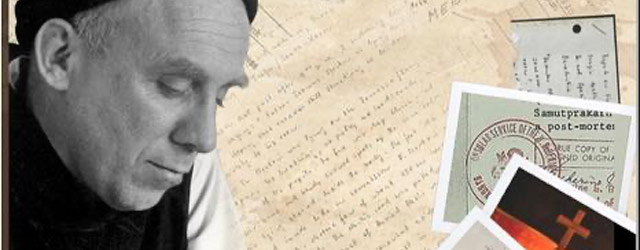
The investigation into the strange death of the celebrated author and Trappist monk Thomas Merton continues and reaches new heights with this fascinating and detailed examination by authors Hugh Turley and David Martin—a riveting sequel to their first book The Martyrdom of Thomas Merton.

The authors present a powerful argument supported by new information and detailed analyses to support their thesis that Merton was most likely murdered for speaking out against the Vietnam War.

They quote the Thai police report that states that Merton died of a ‘heart failure’ not by being electrocuted by a faulty fan as disseminated by the mainstream press and they expose outright falsehoods such as the lie most likely from the Abbey spokesperson and printed in a Kentucky newspaper that an autopsy of Merton’s body was conducted in California—when no such autopsy occurred.

Also missing from the Thai police report–as noted by Turley—is that there was no examination of Merton at the scene of the accident and no mention of the gaping wound at the back of Merton’s head—which suggests that Merton may have been shot at close range by a silencer gun. Also there was no mention of Merton’s body being wet in the Thai police report—which would contradict the false narrative that Merton had stepped out of the shower and grabbed the fan and was electrocuted—this latter scenario was manufactured five years after Merton’s death by Brother Patrick Hart in an effort to strengthen the false narrative that Merton was electrocuted.

Brother Patrick Hart, the secretary assigned to Merton before his trip was the longtime secretary to Abbot James Fox—Merton’s nemesis, a conniving character who looms large in the book as one of the principal conspirators.

The mysterious Belgian Benedictine monk Father Francois de Grunne—the last person seen with Merton alive and the discoverer of Merton’s body reappears. His behavior is suspicious—to the point that one may easily pose the question was his job to deliver Merton to the professional assassin?  

Both before and after the discovery of Merton’s body—others at the scene commented on de Grunne’s strange behavior and his unusual comments that seemed odd and inappropriate given the tragic circumstances. And in 2017 when Hugh Turley reached out to de Grunne’s Abbey he was given no information about de Grunne —it was as if de Grunne had disappeared into thin air.

Turley expertly and methodically identifies the betrayers of Thomas Merton—and there are many—and the secrecy surrounding their conversations about what information to conceal regarding Merton’s death.

Also peculiar is why Merton was suddenly approved to go on such an extended trip to Thailand and other destinations. This is extraordinary in itself and worth noting since his prior Abbot James Fox denied Merton any excursion outside the Abbey other than a short trip to town for a medical appointment.

Also worth noting is the fact that Merton was asked to sign a document bequeathing all royalties to the monastery upon his death. This appeared to be a precondition for his journey being approved—a document that seemed to have some urgency. The signed document bequeathing all royalties from his literary estate to the Abbey upon his death is significant since Merton had often requested to be transferred to other monastic orders—requests that were repeatedly denied.

There seems to be a Machiavellian plot at the center of Merton’s untimely demise with many players involved—all conspiring to cover up the death of the greatest and most important contemplative of the 20th century. The mystery of his death has lain dormant for years until the scholarship, courage and sleuthing skills of Turley and Martin came upon the scene and uncovered new information that may one day if not sooner crack this case wide open and bring justice to Thomas Merton.

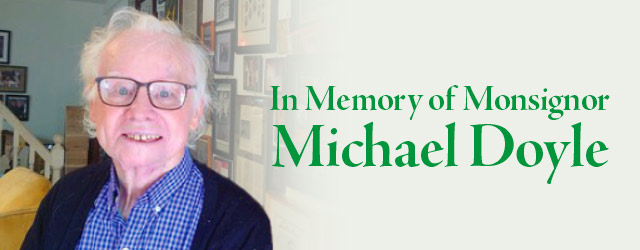
In Memory of Monsignor Michael Doyle

By Norbert McDermott

Photo Courtesy of Norbert McDermott

His reputation went before him. I heard and/or read a lot about him and his accomplishments before I met him. Then it all made sense. Right away one felt a steely calmness, gentleness, with an underlying determination.

One could not but be impressed by his demeanour – the manner in which he stood for the underprivileged in a declining neighborhood; his sense of conviction that this could only be changed via education; but knowing that it is difficult to educate on an empty stomach he set about repossessing and rebuilding derelict properties in the neighborhood.

This was his favourite reading corner.
Photo | Norbert McDermott

He had the charisma as well as the understated drive to attract supporters to the cause – and privately raised large amounts of dollars over the past decades to make it possible. Today his school accepts pupils of every denomination – and is thriving.

His assigned parish happened to be the “Heart of Camden” – and he made it the beating heart of Camden.

A recent documentary on his life summarized it well “As a young priest, Father Michael J. Doyle came to the U.S. from rural Ireland in 1959, bringing with him a joyful disposition, a fervent Catholic faith and an unwavering determination to help his congregation and community. These traits were put to the test in Camden, where he found himself confronted with urban decay and despair. Industries were closing and people were leaving. Crime, drug use, the breakdown of families, the proliferation of hopelessness—this was Camden’s reality”

Monsignor Michael Doyle and Norbert McDermott
Photo | Norbert McDermott

I was a regular visitor to Camden for some “fireside chats” over the years – he hailed from a very rural area of east Longford quite close to the Cavan border… and I had a close affinity with those parts having been born and raised in Oldcastle on the Meath/Cavan/Westmeath border. At our first meeting he enquired where I live now. I told him Oreland near Fort Washington/PA – “that’s easy” sez he “it’s just Ireland with an “O” – funny I recalled my mother was the only other person I heard make such an association!

Some 7 to 8 years ago he had a serious battle with cancer of the jaw – but Fox Chase Cancer Center did a great job for him – and I visited him in the rectory shortly after he was released.

And here he is with a book I gave him…. note the music connection with the HMV (His Masters Voice) memorabilia on the wall…. a true ikon of Camden fame when it was in its heyday.
Photo | Norbert McDermott

And I was thrilled, with in-person visits being off limits for a few years due to Covid, that I made my most recent visit on Bloomsday, June 16, this year – and caught up with him in his “retirement home” – a little row house on a side-street right across from the church and the school at the Sacred Heart of Camden – he took a lot of pleasure from watering the shrubs outside on his sidewalk and watching the comings and goings of the schoolkids.

Over the years I raised circa $10,000 for the school each year and before leaving he always thanked me for that. And I so clearly remember his parting words when I said goodbye to him on Bloomsday…. as I turned on my heel he quipped “when I’m gone you’ll be adding inflation to that – won’t you?” with the usual twinkle in his eye….

He had a way about him – so I guess, with or without his presence, I am now obliged to continue the practice.

RIP.

He had a terrific picture gallery – some of which you can see here.
Photo | Norbert McDermott